
Posterior access neck lift
Proprietary technique for the correction of posterolateral and inferior cervical flaccidity, without the need for incisions in the anterior aspect of the neck. It combines the standard surgical approach of the cervical lift with a proprietary structural maneuver: posterosuperior traction of the platysma anchored to the mastoid fascia.
Rejuvenate the neck without scarring on its anterior aspect.
When the neck flaccidity is concentrated on the sides and the lower part, this technique allows to solve it by working from behind, without touching the front area.
– 01 / For the patient
What is posterior access neck lift?
It is a neck rejuvenation technique developed by Dr. García Ceballos for a specific situation: patients in whom the flaccidity is concentrated on the sides and lower part of the neck, and not on its anterior face. In these cases, conventional techniques requiring a submental incision – in the chin area, just below the chin – can be avoided.
The incision used is the usual neck lift incision: it runs along the hairline of the temple, down behind the ear and extends to just in front of the ear lobe. This scar is hidden between the hair and the natural folds of the ear, and is not visible under normal conditions.
What distinguishes this technique is not where you enter, but how you work once inside: instead of acting on the midline of the neck from the anterior aspect, the entire procedure is performed from the posterior and lateral compartment. The platysma muscle – primarily responsible for the appearance of the neck – is pulled upward and backward, and anchored to a firm internal structure called the mastoid fascia, which ensures that the result remains stable over time.
Why is it called “post-access”?Not because of the incision -which is the conventional one in cervical lifting- but because of the direction of the whole surgical work. The access route to the platysma muscle, the direction of traction and the anchor point are posterior. The surgeon works from the back to the front, without the need to enter through the anterior aspect of the neck.
– 02 / For the patient
Which patients is it aimed at?
Not all neck problems are solved in the same way. The choice of technique depends on where the sagging is concentrated. Two situations should be distinguished:
- Central flaccidity – in the anterior aspect of the neck, below the chin, with vertical platysma bands or excess submental fat: in these cases, Dr. García Ceballos combines the posterior cervical lift with a vertical vector facelift. This combination corrects central sagging by elevation from above, without the need for a submental incision in the anterior aspect of the neck.
- Posterolateral or lower flaccidity – when the neck has lost firmness mainly on the sides and lower part, without a significant central component -: here the isolated posterior neck lift, complemented with cervical liposuction, is the main indication.
It is also an option to be considered in patients who, for personal or professional reasons, prefer to avoid the submental scar whenever technically possible.
In the first consultation we evaluate which of the two profiles corresponds to your case and, if necessary, we indicate that the most appropriate technique would be a conventional alternative. The criterion is always to seek the best result for you, not to apply a particular technique at all costs.
– 03 / For the patient
What does this technique offer you?
When the neck flaccidity is predominantly posterolateral, this technique offers three specific advantages over a conventional anterior incision approach:
- No scars on the anterior aspect of the neck. The front of the neck, especially the submental area, is not touched. This reduces the number of visible scars.
- Stable structural result. The anchorage to the mastoid fascia – a rigid and resistant internal structure – prevents the sutures from shifting over time, which contributes to the result being maintained in the long term.
- Simplified postoperative period. Avoiding the submental incision simplifies care of the anterior neck area in the days following surgery.
It should be emphasized, however, that these advantages only materialize in the appropriate patient profile. Applied outside its indication, the technique would produce a worse result than that of a conventional approach.
Technical-scientific block
Rationale, technical description of the access, suture configuration, material used, indication criteria and surgical precautions.
– 04 / Technical block
Basis of the technique
Surgical treatment of cervical flaccidity has historically been based on two compartments. The anterior compartment, traditionally approached through a submental incision, allows to act on the midline: correction of the anterior platysmal bands, submental lipectomy, plication of the cervical linea alba. The posterolateral compartment, approached through the conventional cervical lift incision (temporal capillary transition line, retroauricular descent, preauricular extension to the lobe), allows redistribution of the lateral and posterior tissues.
When the patient’s flaccidity is predominantly concentrated in the posterolateral or inferior compartment, with no significant central component, the anterior approach with a submental incision adds an additional scar without providing a proportional structural benefit. The posterior access technique builds on this clinical observation: to resolve posterolateral sagging exclusively from the posterolateral compartment, without intervening on the anterior aspect of the neck.
When there is a significant central component, Dr. Garcia Ceballos’ preference is not to use the anterior approach but to combine the posterior cervical lift with a vertical vector facelift. This strategy allows correction of the central flaccidity by supramentonian elevation, avoiding the submental incision even in these patients.
The differential structural element is the anchorage of the platysma to the mastoid fascia by means of a bearded polydioxanone suture in an inverted U configuration. The mastoid fascia is a rigid tendinous structure that acts as a fixed point, preventing suture migration and preserving the traction applied to the platysma over time. This characteristic is what allows us to obtain a structurally stable result working only from the posterolateral compartment.
– 05 / Technical block
Technical description
Surgical access
The approach is the conventional cervical lift approach: the incision runs along the temporal hairline transition, down the retroauricular region and extends to immediately in front of the auricular lobe. The incision, once consolidated, is concealed in the hairline and the natural folds of the auricle.
After controlled skin dissection towards the posterolateral and inferior compartment of the neck, access is gained to the posterior aspect of the platysma muscle, where the structural maneuver is performed.
Structural maneuver on the platysma
A controlled posterosuperior traction is performed on the posterior platysma, gathering the muscle towards the mastoid region. The traction is fixed by suture anchored to the mastoid fascia, which acts as a fixed point:
- Suture configuration: inverted U-shape, hugging the posterior portion of the platysma and returning the thread to the anchor point on the mastoid fascia.
- Material: Quill PDO suture (bidirectional barbed polydioxanone). The suture barbs allow progressive anchoring in the tissue without the need for knots, and provide resistance to migration along the entire length of the thread.
- Objective: to reposition the posterolateral platysma in an elevated and stable posterior position, anchored to a rigid tendon structure that maintains traction over time.
Complementary cervical liposuction
As a routine complementary procedure, cervical liposuction is performed in the same surgical act (not lipectomy). It has a double function: to facilitate the evacuation of volume from the cervical compartment, optimizing the aesthetic effect of platysmal traction, and to stimulate the tissue scar response of the area, contributing to the consolidation of the result in the long term. Liposuction is preferred over lipectomy because of its less tissue aggressiveness and the additional stimulating effect on the surrounding tissues.
Closure and skin resection
Once the structural correction of the platysma is completed, the skin envelope is redistributed, the skin resection is performed according to the excess generated by the traction and the closure is performed in planes. The incision is closed using the usual technique of conventional cervical lifting.
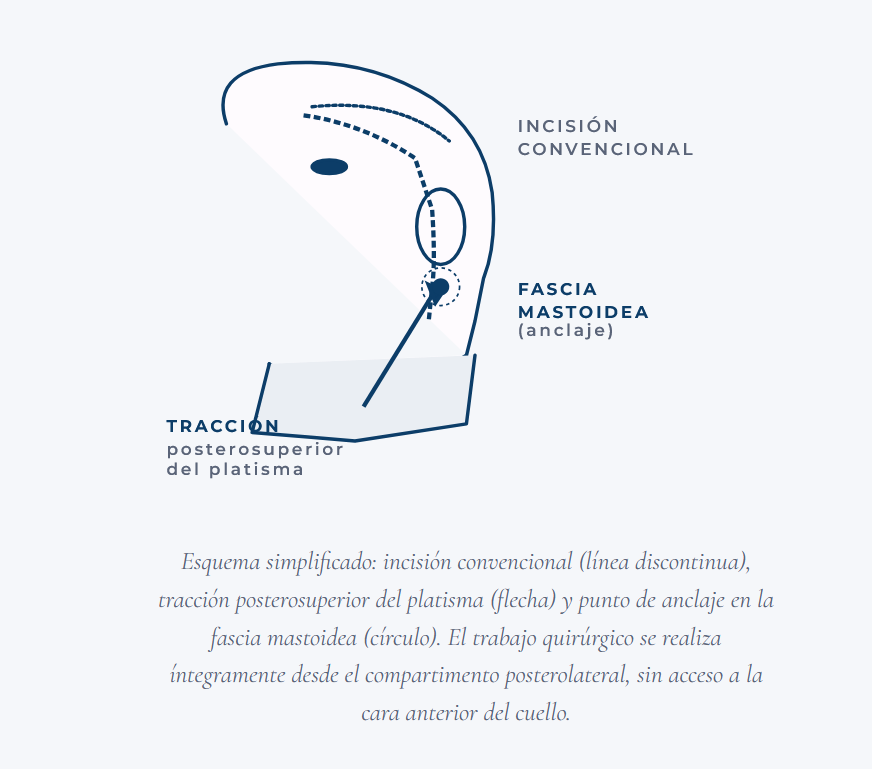
– 06 / Technical block
Key components of the technique
| Component | Description |
|---|---|
 Approach to the platysma |
Posterolateral. The muscle is approached from its posterior aspect, without access to its anterior portion or to the cervical midline. |
 Direction of traction |
Posterosuperior. The platysma is collected and redirected towards the mastoid region, as opposed to the direction of the cervical ptosis. |
 Anchor point |
Mastoid fascia. Rigid tendon structure that acts as a fixed point, preventing progressive migration of the sutures and maintaining traction over time. |
 Suture used |
Inverted U-shaped PDO quill. Reabsorbable polydioxanone barbed suture with barbs that provide progressive anchorage without the need for knots. The inverted U configuration hugs the platysma and returns the thread to the mastoid anchorage point. |
– 07 / Technical block
Indications and patient selection
| Clinical pattern | Recommended approach |
|---|---|
| Posterolateral or inferior cervical flaccidity, without significant central component, without prominent anterior platysmal bands or relevant submental excess. | Isolated posterior access (main indication), with complementary cervical liposuction. |
| Mixed cervical flaccidity with predominant posterolateral component but also central component. | Posterior access + vertical vector facelift, combination assessed on a case by case basis. |
| Predominantly central cervical flaccidity, with marked anterior platysmal bands or significant submental excess. | Vertical vector facelift combined with posterior cervical lift. This combination allows correction of central flaccidity by supramentonian elevation without the need for a submental incision. |
| Complete facelift with associated cervical flaccidity. | Vertical vector facelift + posterior cervical component, according to individual pattern. |
Surgical precautions
The main pitfall of the technique is the preservation of the mandibular marginal branch of the facial nerve, whose anatomical proximity to the territory of action makes a meticulous technique essential. As an operative safety criterion, the suture closest to the mandibular branch should be approximately 1.5 cm inferior to it, maintaining a consistent safety margin with respect to the nerve pathway.
Other noble structures to respect include the greater auricular nerve, the external jugular vein and the terminal branches of the superficial cervical plexus.
– 08 / Technical block
Recognized limitations and state of the evidence
- Restricted indication. As with any technique with a specific profile, its application outside the indication produces inferior results. Patient selection is an inseparable part of the procedure.
- Restricted indication and specific combinations. In the presence of prominent anterior platysmal bands, significant submental excess or marked central sagging, the posterior cervical lift alone does not resolve the problem. Dr. Garcia Ceballos’ preference is to combine the posterior cervical lift with a vertical vector facelift, thus avoiding the anterior approach with a submental incision. This strategy is not suitable for all cases: each patient requires individual assessment.
- Learning curve. The handling of the barbed sutures and the inverted U configuration with anchorage to the mastoid fascia require specific technical familiarity. Replication by other surgeons would require dedicated training.
- Unpublished clinical evidence. The technique is part of the clinical practice of Dr. García Ceballos but has not been formally published in a scientific journal. External validation by independent teams and formal publication are pending work that would strengthen the available evidence.
Despite these limitations, the technique fulfills its objective in the patient profile for which it is intended: to resolve posterolateral and inferior cervical flaccidity with stable structural support, avoiding incisions on the anterior aspect of the neck when these are not strictly necessary.
– 09
Associated resources
Frequently Asked Questions
It is a technique developed by Dr. García Ceballos to correct the flaccidity of the neck working exclusively from the posterolateral compartment, without the need to make incisions in the anterior face of the neck. The scar is placed in the usual cervical lifting area (hairline and retroauricular region), but the structural maneuver is performed on the posterior aspect of the platysma, pulling it upward and backward and anchoring it to the mastoid fascia, a rigid structure that prevents the sutures from moving.
Because what defines the technique is not where the incision is made, but where the work is performed once inside. In this technique, all the surgical work is performed in the posterolateral compartment of the neck: the approach to the platysma muscle, the direction of traction and the anchor point are posterior. It is a posterior access in a functional sense, as opposed to the anterior access used when working on the midline of the neck.
It is indicated for patients with predominantly posterolateral or lower cervical flaccidity, that is, whose main problem is on the sides and lower neck, and does not require anterior midline correction. It is also an option for patients who prefer to avoid submental or anterior neck incisions.
The main advantage, in the right patient profile, is that it avoids the submental incision or any scar on the anterior aspect of the neck. This reduces the number of visible scars and simplifies the postoperative period. It should be clarified that not all patients are candidates for this technique alone: when there is significant central sagging, Dr. García Ceballos prefers to combine it with a vertical vector facelift rather than resorting to an anterior approach with a submental incision.
Quill PDO sutures are threads of polydioxanone, a resorbable material, equipped with small barbs (“bearded” sutures) that anchor in the tissue as they advance. These barbs eliminate the need to tie knots to fix the suture and allow progressive anchoring along the entire length of the thread, which makes them particularly useful for controlled tractions such as those required by this technique.
It is not a question of greater or lesser safety, but of suitability to the case. Any cervical surgery technique, including this one, requires meticulous care not to damage nearby noble structures, especially the marginal mandibular branch of the facial nerve. As an operative criterion, the suture closest to the mandibular branch should be approximately 1.5 cm inferior to it, maintaining a consistent safety margin. What this technique offers is the possibility of resolving posterolateral cervical flaccidity without resorting to anterior incisions when these are not strictly necessary.
The technique has not been formally published in a scientific journal. It is a technique developed and applied in the clinical practice of Dr. García Ceballos, integrated in his portfolio of facial and neck surgery procedures.
Yes, as a routine complementary gesture, cervical liposuction is performed in the same surgical act -not lipectomy-. It has a double function: to facilitate the evacuation of volume from the cervical compartment, optimizing the esthetic effect of the platysma traction, and to stimulate the tissue scar response of the area, which contributes to the consolidation of the long-term result.
Other contributions by Dr. García Ceballos
The posterior access cervical lift is part of the set of techniques and systems developed by Dr. García Ceballos throughout his career. You can consult the rest of his contributions in the Clinical Innovation section.
The indication is evaluated in a first consultation by clinical examination of the cervical flaccidity pattern. If your case requires an anterior approach, you will be told frankly which technique offers the best result in your particular situation.