
Anatomical vs. Round Implants: A Technical Comparison
The choice between anatomical (teardrop-shaped) and round implants is one of the most important technical decisions in breast augmentation. Shape, profile, how they look when standing and lying down, durability, and which type of patient each is best suited for.
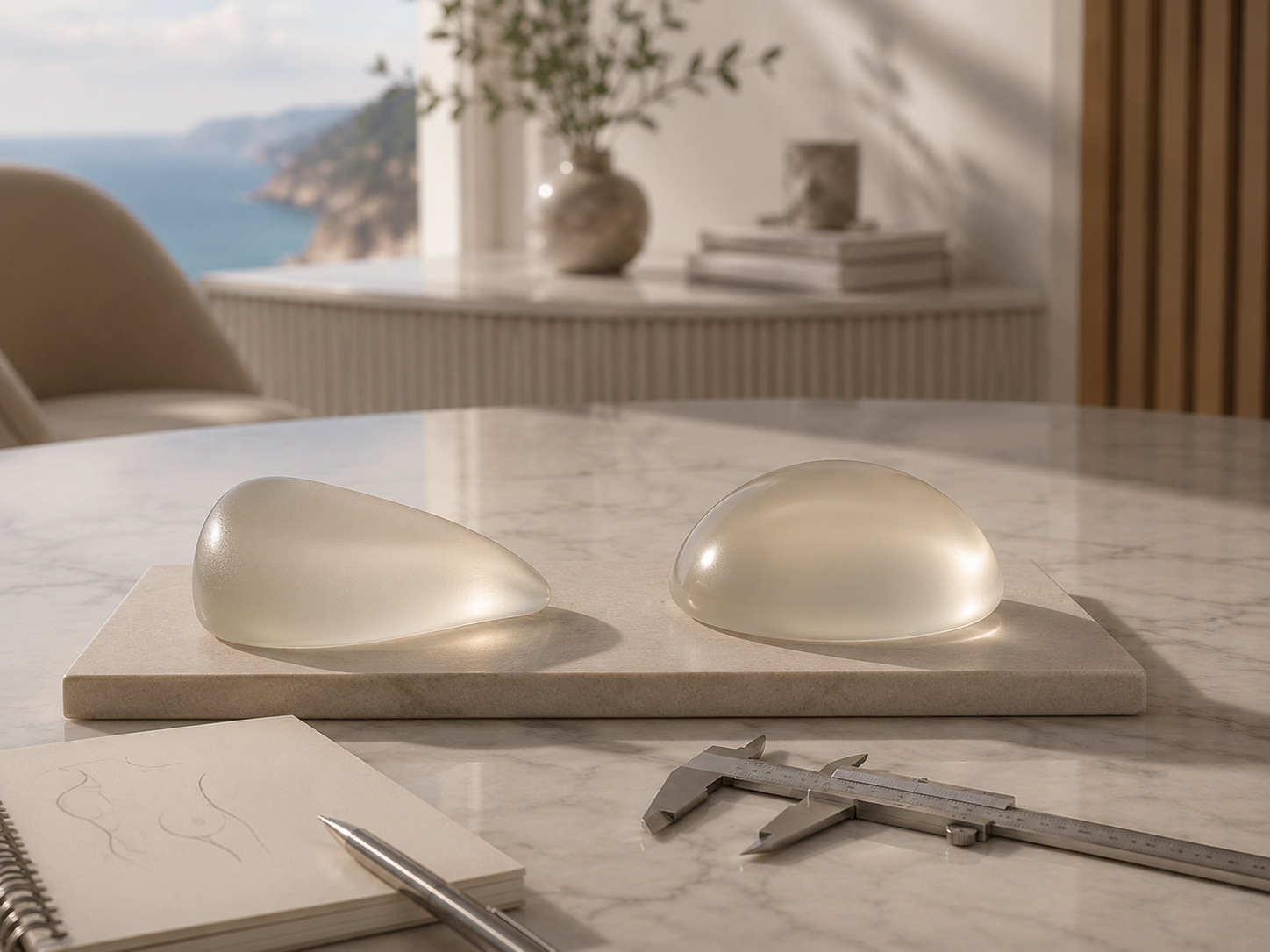
Round implants produce a fuller appearance at the upper pole and have become the standard over the past decade due to their simplicity and the fact that they do not rotate. Anatomical (teardrop-shaped) implants produce a more natural result—they mimic the natural shape of the breast when standing—but they can rotate within the pocket, losing their desired effect. The choice depends on the patient’s anatomy, the desired aesthetic result, and the quality of her own breast tissue. There is no “best” option; there is simply the most appropriate one for each individual case.
A technical decision with aesthetic implications
When a patient comes in for a breast augmentation consultation, one of the most frequently asked technical questions is about the shape of the implant: anatomical (teardrop) or round? The answer is not straightforward, and the choice has a direct impact on the final appearance, the naturalness of the result, and potential specific complications such as rotation.
This article discusses the technical differences between the two types of prostheses, the objective indications for each, and practical considerations. The final choice is made by the surgeon during the consultation, based on each patient’s anatomy and individual goals—but understanding the differences helps the patient play a more active role in that decision.
What Are Anatomical (Teardrop-Shaped) Implants?
Anatomical implants, also known as “teardrop” or “tear-shaped” implants, have an asymmetrical shape: less volume at the upper pole and more volume at the lower pole. The design concept is to mimic the natural shape of a young breast when the patient is standing. Visually, in a standing patient, the result is a gentle slope from the cleavage toward the nipple, with greater projection in the lower portion.
All anatomical implants have a textured surface (the implant surface is rough, not smooth): this is necessary because the texture allows for adhesion to the surrounding tissue and prevents—or reduces—rotation within the surgical pocket. If an anatomical implant were to rotate, the larger pole would end up at the top instead of the bottom—a highly unfavorable aesthetic outcome.
What Are Round Prostheses?
Round implants have a symmetrical shape: the volume is distributed in a circular pattern, with the same volume at the upper pole as at the lower pole. When the patient is standing, gravity partially redistributes the volume downward, but the upper pole remains fuller than in an anatomical implant.
Round implants can be textured or smooth. Smooth implants have a completely smooth surface and reduce certain complications, although they are associated with slightly higher rates of capsular contracture in some studies. Because they are symmetrical, rotation is not a cosmetic issue (there is no “top” or “bottom”).
Key Differences in the Results
Appearance of the upper pole
This is probably the most significant aesthetic difference:
- Anatomical: less voluminous upper pole, gentle slope, natural “upright” appearance. The cleavage is more discreet.
- Round: a fuller, more prominent upper pole; a more visible cleavage; a more “spherical” appearance. Some patients are looking for exactly this effect.
Appearance when lying down
This is a less-discussed but important difference:
- Anatomical: When the patient is lying on her back, they retain their teardrop shape to a certain extent, which gives the breast a somewhat “stiff” appearance when lying down.
- Round: When the patient is lying down, the contents redistribute due to gravity, giving the breast a more natural, “drooping” appearance when lying down (mimicking the behavior of the natural breast in that position).
Turnover Risk
The specific risk associated with anatomical implants is rotation: the implant may rotate within the surgical pocket, especially during the first few months. If it rotates more than 20–30 degrees, the aesthetic result is compromised and may require reoperation to reposition it. Rotation of round implants is aesthetically irrelevant.
Visual Comparison
| Parameter | Anatomical (gout) | Round |
|---|---|---|
| Shape | Asymmetrical (less at the top, more at the bottom) | Symmetrical (same at the top and bottom) |
| Top-tier result | More subtle, natural "standing" look | Fuller, more visible neckline |
| Lying-down result | Retains its teardrop shape | It redistributes under the influence of gravity (more natural) |
| Surface | Always textured | Textured or smooth |
| Risk of cosmetically significant rotation | Yes, approximately 1–5%, depending on the series | No (it is symmetric) |
| Capsular Contracture Rate | Low (textured) | Low (textured) / Moderate (smooth) |
| Preferred Indications | Very thin patients, tuberous breasts, desire for the most natural-looking result | General cases, patients seeking a full upper pole, patients with good native tissue |
When to Choose One or the Other
In Favor of Anatomical Shoes
- Very thin patients with thin skin, where a full upper pole would look unnatural
- Tuberous Breast: A Procedure to Lengthen the Breast and Give It a Teardrop Shape
- Explicitly seek the most natural-looking result possible, without an artificially prominent cleavage
- Active female gym-goers whose toned upper body must complement their figure
In Favor of Round Ones
- Explicit search for a high-neck top with a visible neckline
- Patients with good natural breast tissue that already has a natural teardrop shape; the implant simply adds volume
- Revision surgeries for previous breast augmentation procedures involving implants that have rotated
- Preference for a more natural-looking breast when lying down
- Highly active patients who would require frequent rotation
Market Trends Over the Past 10 Years
Until around 2015, anatomical implants accounted for a significant share of the European market, especially among surgeons who valued a natural look above all else. In recent years, however, the pendulum has swung toward round implants due to several factors:
- No risk of rotation: simplifies monitoring and eliminates a cause for reoperation
- A more natural appearance when lying down: in patients who spend a lot of time lying down (mothers, athletes), round implants perform better
- Current beauty trends: Social media has popularized breasts with visible upper poles, which align with the round ones
- Advances in textures: Modern round prostheses with a polyurethane coating combine a low risk of rotation (due to adhesion) with the symmetry of round prostheses
This does not mean that anatomical implants have disappeared: they remain the best choice in specific cases (tuberous breasts, very thin patients, reconstructions), and for surgeons with extensive experience using them. The decision is still made on a case-by-case basis.
The Other Key Issue: Silicone vs. Polyurethane
In addition to their shape (anatomical or round), implants differ in the material used for their outer layer. Polyurethane implants—which can be round or anatomical—have a special outer layer that significantly reduces capsular contracture, the most feared long-term complication of breast augmentation. At Mallorca Medical Group, we offer all three options (textured silicone, smooth silicone, polyurethane), and the choice is made on a case-by-case basis depending on the patient.
Bibliographic References
- Adams WP Jr, Mallucci P. Breast augmentation: patient selection, implant choice, and surgical planning. Plast Reconstr Surg, 2012.
- International Society of Aesthetic Plastic Surgery (ISAPS). Global Survey on Aesthetic Procedures, 2024. isaps.org
- Spanish Society of Plastic, Reconstructive, and Aesthetic Surgery (SECPRE). Consensus Statement on Breast Implants, 2023. secpre.org
FAQ — Anatomical vs. Round Implants

Dr. José Ignacio García Ceballos
Member nº 070707779 - Official College of Doctors of the Balearic Islands
Plastic surgeon with 25 years of experience. Trained at the Royal College of Surgeons of England (MRCS I England) and in Belgium (FCCP Belgium). Member of SECPRE. Creator of two patented techniques: BAGS (mastopexy) and Duvet (rhinoplasty).
It operates at Quirónsalud Palmaplanas Hospital and Quirónsalud Son Verí Hospital in Palma de Mallorca. Multilingual care is available in Spanish, English, French, and German.
Camí de la Vileta, 46 C - 07011 Palma de Mallorca - 971 254 686
Medical Disclaimer: The content of this article is for informational purposes only and is not a substitute for an individualized medical consultation with a board-certified plastic surgeon. Any decision regarding surgery requires a personalized evaluation.