
Polynucleotides in Mallorca: Salmon DNA treatment | MMG
Polynucleotides in Mallorca: facial biostimulation with salmon DNA to improve skin quality
Polynucleotides in Mallorcaalso known as PDRN or salmon DNA treatment, have been incorporated into regenerative aesthetic medicine as an option to improve the quality of the skin without adding artificial volume or modifying facial expression. Its objective is not to “fill” or paralyze the muscle, but to stimulate the natural mechanisms of skin repair.
At Mallorca Medical Group, this treatment is valued within a personalized medical approach to Cosmetic Medicine Treatments in Mallorca, especially in patients who wish to improve hydration, luminosity, firmness, texture and skin elasticity through a progressive, natural and minimally invasive procedure.
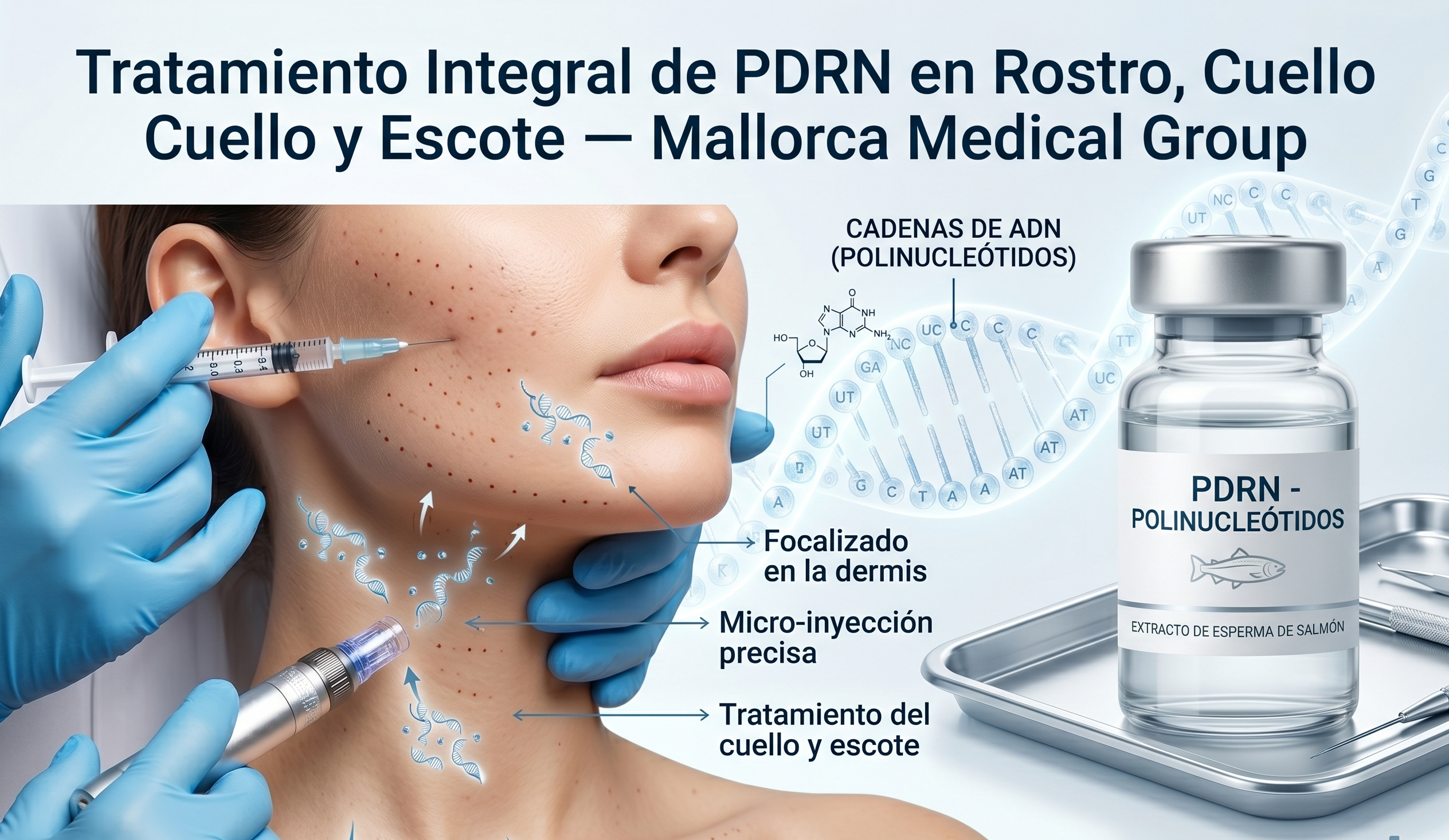
What are polynucleotides and why are they used in aesthetic medicine?
Polynucleotides are nucleotide chains, i.e. purified DNA fragments, which are used in aesthetic medicine for biostimulatory purposes. In many products used in the medical-aesthetic field, they come from controlled purification processes of DNA of salmonid origin, which is why they are popularly known as salmon DNA treatment.
It is important to clarify what they are not. Polynucleotides are not a dermal filler designed to increase volume, as may be the case with some hyaluronic acid treatments. Nor are they a toxin designed to relax facial muscles, as is the case with botulinum toxin. Their main function is to progressively improve skin quality through mechanisms related to hydration, repair, elasticity and dermal support.
Polynucleotides are therefore part of the so-called regenerative aesthetic medicine, a trend that seeks to improve the skin from its biological structure and not only to correct wrinkles or volumes immediately. This approach can be especially interesting for patients seeking a discreet, progressive result compatible with a natural facial expression.
How polynucleotides act on the skin
To understand how polynucleotides work, the skin can be imagined as a living structure in constant renewal. With the passage of time, sun exposure, oxidative stress, pollution, hormonal changes and natural aging, the activity of the cells responsible for maintaining skin firmness and elasticity is progressively reduced.
Polynucleotides act as biostimulators. They aim to promote a more suitable skin environment for the skin to improve its hydration, repair capacity and structural matrix. In simple terms, they do not replace or artificially replenish the skin, but try to stimulate its own recovery mechanisms.
Fibroblast, collagen and elastin stimulation
Fibroblasts are fundamental cells of the dermis. They are involved in the production of collagen, elastin and other components of the extracellular matrix. These structures are responsible for skin firmness, elasticity and density.
With age, fibroblast activity decreases. Polynucleotides may help to partially reactivate these processes, leading to better skin texture, greater elasticity and a healthier appearance. Recent medical literature describes promising results in improving skin texture, elasticity and fine wrinkles, but also underscores the need for further clinical research to establish optimal protocols.
Deep hydration and improvement of the dermal matrix
One of the reasons patients notice improvement after treatment is the ability of polynucleotides to promote a more hydrated dermal environment. Dehydrated skin often appears dull, thin, fragile and more prone to surface lines.
By improving deep hydration and the quality of the extracellular matrix, the overall appearance of the skin can become more even, luminous and rested. This effect should not be confused with an increase in facial volume: the goal is to improve tissue quality, not to change the proportions of the face.
Antioxidant action and support for skin repair
Oxidative stress is one of the major contributors to skin aging. Sun exposure, smoking, environmental pollution and other external factors generate free radicals that damage cellular structures and accelerate the loss of skin quality.
Polynucleotides have been studied for their potential role in tissue repair, inflammation and regeneration processes. In aesthetic medicine, this capacity translates into a growing interest in their use in facial rejuvenation protocols, scar improvement and recovery of skin quality after medical-aesthetic procedures.
Benefits of polynucleotide treatment in Mallorca
The benefits of polynucleotides usually appear progressively. Unlike other treatments that offer immediate change, biostimulation takes time. The skin must respond to the stimulus, reorganize its dermal matrix and gradually improve its hydration, elasticity and density.
Benefits that may be seen in well-selected patients include:
- Improved facial radiance.
- Appearance of more hydrated and rested skin.
- Improved skin texture.
- Attenuation of fine lines and superficial wrinkles.
- Increased sensation of firmness in skin with incipient flaccidity.
- Progressive improvement of elasticity.
- Support in scar improvement protocols, especially selected acne scars.
- Better skin quality before or after other medical-aesthetic treatments.
The desired result is not an abrupt transformation, but a better quality, more uniform and healthier looking skin. For this reason, the treatment may be suitable for patients who want facial rejuvenation without surgery and prefer to avoid excessive or artificial changes.
In which areas can polynucleotides be applied?
Polynucleotides can be applied in different areas, always after medical evaluation. The indication will depend on the thickness of the skin, the degree of aging, the presence of fine wrinkles, loss of elasticity and the patient’s objectives.
Eye Contour
The eye contour is one of the most delicate areas of the face. The skin is thin, sensitive and tends to show signs of aging early. In selected patients, polynucleotides can help improve the quality of this skin, especially when there is fine texture, tired appearance or superficial wrinkles.
When the main problem is excess skin, eyelid bags or structural drooping of the eyelid, it may be necessary to evaluate other procedures, such as blepharoplasty, within an individualized medical evaluation.
Full face
On the face, polynucleotides can be used to improve luminosity, texture and overall elasticity. They are especially useful in patients who report dull, thin, dehydrated skin or early signs of aging.
Neck and neckline
The neck and décolleté are areas where the skin tends to age visibly due to sun exposure, loss of elasticity and dermal thinning. Polynucleotides can be part of a skin improvement plan in these areas, especially when there is mild sagging or fine wrinkles.
Back of hands
The hands are a frequently neglected area, even though they show obvious signs of aging. In some cases, biostimulation can be combined with other treatments to improve texture, hydration and skin quality.
Acne scars and irregular texture
In skin with acne scars or scarring, polynucleotides can be used as an adjunct to other procedures, such as medical lasers, peels or medical microneedling, provided there is an appropriate indication. They are not a substitute for all scar treatments, but can help to improve the dermal environment and tissue recovery.
Polynucleotides, hyaluronic acid and botulinum toxin: main differences
A frequent doubt in consultation is whether polynucleotides replace hyaluronic acid or botulinum toxin. The answer is no. They are different treatments, with different objectives, although they can be complementary within a well-designed medical plan.
| Feature | Polynucleotides | Hyaluronic acid | Botulinum toxin |
|---|---|---|---|
| Main mechanism | Biostimulation and improvement of skin quality | Moisturizing, projection or volume replenishment depending on the product | Selective muscle relaxation |
| Main Objective | Improve texture, hydration, firmness and elasticity. | Correct furrows, contours or loss of volume | Attenuate dynamic expression wrinkles |
| Result | Progressive and natural | Usually more immediate | Visible progressively in a few days |
| Usual indications | Dull, thin, dehydrated skin or skin with superficial wrinkles. | Loss of volume, furrows or need for support | Expression wrinkles on forehead, frown lines or crow’s feet. |
| Approach | Regenerative | Corrective or structural | Preventive and corrective |
In many cases, polynucleotides can prepare the skin prior to other treatments or complement their results. For example, a more hydrated and better quality skin may respond better to aesthetic medicine procedures, laser or facial rejuvenation treatments.
How is a polynucleotide session step by step?
The patient experience is usually simple and outpatient. Even so, it should always be performed in an appropriate medical environment and by qualified professionals, since it is an injectable procedure that requires anatomical knowledge, clinical judgment and safety measures.
Initial medical evaluation
It all starts with a consultation. During this visit, the quality of the skin, the degree of aging, the presence of flaccidity, fine wrinkles, scars, medical history and expectations of the patient are analyzed. This phase is fundamental to decide if polynucleotides are adequate or if another treatment should be prioritized.
2. Design of the treatment plan
Not all patients need the same protocol. The number of sessions, the area to be treated and the combination with other procedures must be individualized. In some cases the treatment is oriented to the eye contour; in others, to the entire face, neck, neckline or scars.
3. Application by microinjections
The procedure is performed by means of very fine microinjections in the selected areas. The duration is usually short, approximately 20 to 40 minutes, depending on the treated area and the indicated protocol.
4. Aftercare
After the session, redness, slight inflammation, small transitory papules or a punctual hematoma may appear. These effects are usually temporary and usually resolve within a few days. It is recommended to avoid intense exercise, excessive heat, sauna, direct sun exposure and manipulation of the area during the first hours or according to the medical indication received.
5. Progressive results
Results are not immediate. Improvement appears progressively over the weeks, as the skin responds to the biostimulatory stimulus. This point is essential to adjust expectations: the treatment aims to improve the quality of the skin, not to produce an abrupt change in volume or expression.
How many polynucleotide sessions are recommended?
Many protocols recommend an initial cycle of 2 to 4 sessions, separated by several weeks. However, this guideline may vary depending on skin condition, age, area treated, degree of photoaging and patient goals.
After the initial cycle, some patients may benefit from maintenance sessions. The frequency should be decided on an individual basis, avoiding rigid protocols or unnecessary treatments.
For whom is polynucleotide treatment indicated?
Polynucleotides may be indicated for men and women who wish to improve the quality of their skin in a progressive and natural way. They are often of particular interest from the first signs of aging, although age should not be the only criterion for indication.
It can be assessed in patients with:
- Dull skin or lack of radiance.
- Cutaneous dehydration.
- Superficial fine wrinkles.
- Slight loss of elasticity.
- Irregular texture.
- Photoaging.
- Selected acne scars.
- Desire to improve the skin without obvious volumetric changes.
When there is advanced sagging, significant skin excess or structural facial aging, polynucleotides alone may not be sufficient. In such cases it may be necessary to consider alternatives such as facelifts in Mallorca, combined treatments or surgical procedures as part of a personalized cosmetic surgery plan in Mallorca.
Safety, contraindications and possible side effects
As with any injectable medical-aesthetic treatment, polynucleotides should be performed after professional assessment. Although they are usually well tolerated in selected patients, they are not free of possible side effects.
Among the most common transient reactions may appear:
- Local redness.
- Mild inflammation.
- Sensitivity in the treated area.
- Small bruises.
- Temporary papules or irregularities at the injection sites.
The indication should be evaluated with special caution in patients with a history of relevant allergies, active skin diseases, local infections, pregnancy, lactation or medical pathologies that may contraindicate injectable procedures. Prior medical consultation allows individualizing the decision and reducing risks.
It is also important to differentiate injectable polynucleotides for medical-aesthetic use from topical cosmetic products containing PDRN-related ingredients. Penetration, stability and clinical evidence are not equivalent. Therefore, it should not be assumed that a cream or serum with PDRN will have the same effect as an injectable medical treatment.
Polynucleotides at Mallorca Medical Group
At Mallorca Medical Group, polynucleotides are integrated within a global vision of medical aesthetics, facial surgery and improvement of skin quality. The objective is not to apply a fashionable treatment, but to determine if it is really the most appropriate procedure for each patient.
The medical assessment allows to decide whether the patient will benefit from polynucleotides, hyaluronic acid, botulinum toxin, laser, medical peels, biostimulators, facial surgery or a prudent combination of several options. The choice should be based on anatomy, skin quality, biological age, expectations and safety.
This approach is especially important in patients comparing different options for Plastic Surgery in Mallorca, Cosmetic Surgery in Mallorca or Cosmetic Medicine Treatments in Mallorca. Regenerative treatments can improve the skin, but they are not a substitute for surgical procedures when there is a clear indication.
For example, a rhinoplasty corrects structural aspects of the nose; a breast augmentation alters breast volume and shape; and reconstructive surgery in Mallorca addresses functional or restorative needs. Polynucleotides, on the other hand, focus on skin quality and gradual rejuvenation without surgery.
Similarly, searches such as Best Plastic Surgeons in Spain, Trusted Plastic Surgery Clinics in Spain, Cost of Plastic Surgery in Mallorca, or Reviews of mallorcamedicalgroup.com often reflect the patient’s interest in safety, experience, transparency, and trust. In aesthetic medicine, these criteria are also relevant: it is not only about the product used, but also the diagnosis, the indication, and the clinician’s experience.
Regarding Free Plastic Surgery Consultations in Mallorca, it is important to clarify that each center may have different policies. At Mallorca Medical Group, the initial medical evaluation is transparently informed to the patient and allows us to establish a personalized, realistic and safe plan.
Frequently asked questions about polynucleotides
What are polynucleotides?
Polynucleotides are purified DNA fragments used in regenerative aesthetic medicine to progressively improve skin quality. Their purpose is to promote hydration, elasticity, radiance and skin repair.
Are polynucleotides the same as hyaluronic acid?
No. Hyaluronic acid can be used to hydrate, lift, or restore volume, depending on the type of product and its intended use. Polynucleotides are primarily intended to improve skin quality through biostimulation.
Does salmon DNA treatment provide volume?
It is not a volumizing treatment. Its main objective is to improve skin texture, hydration, firmness and luminosity without obviously modifying facial features.
When will the results be seen?
Results usually appear progressively over the weeks following treatment. Immediate changes should not be expected as can be seen with some dermal fillers.
How many sessions are needed?
Many protocols recommend 2 to 4 initial sessions, separated by several weeks. The exact schedule should be individualized after medical evaluation.
Can they be combined with other treatments?
Yes. In selected patients they can be combined with hyaluronic acid, botulinum toxin, laser, medical peelings or other aesthetic medicine treatments, always within a personalized plan.
Are they suitable for the eye contour?
They may be useful in some patients with thin skin, superficial wrinkles or loss of skin quality around the eyes. However, when there are bags, excess skin or eyelid drooping, it may be necessary to consider other procedures.
Are polynucleotides a substitute for a facelift?
No. Polynucleotides can improve skin quality, but they do not correct advanced sagging or structural facial drooping. In such cases, it may be more appropriate to consider a facelift or other surgical options.
Conclusion
Polynucleotides in Mallorca represent an interesting option within regenerative aesthetic medicine for patients who wish to improve the quality of the skin without surgery, without volume increase and without artificial changes in facial expression. Its effect is progressive and is based on favoring a more hydrated, elastic and healthy skin environment.
As with any medical-aesthetic treatment, the key is the correct indication. Not all patients need polynucleotides and not all will obtain the same degree of improvement. Therefore, individualized medical assessment is essential to decide whether this treatment is appropriate, whether it should be combined with other procedures or whether there are more effective alternatives for the specific case.
At Mallorca Medical Group, polynucleotide treatment is considered within a personalized strategy of facial rejuvenation, aesthetic medicine and comprehensive skin care.
Sources and references
- Polynucleotides in Aesthetic Medicine: A Review of Current Practices and Perceived Effectiveness. PMC.
- The Effectiveness of Polynucleotides in Esthetic Medicine. PMC.
- Pharmacological Activity and Clinical Use of PDRN. PMC.
- Polydeoxyribonucleotide: A Promising Biological Platform to Accelerate Impaired Skin Wound Healing. PMC.