
Before-and-After Cases: How to Interpret Them Correctly
Before-and-after photos are a useful tool, but they can also be misleading. This educational guide by Dr. García Ceballos explains what to look for when viewing photos during a consultation, what red flags to avoid, and why the best reference photo is your own.
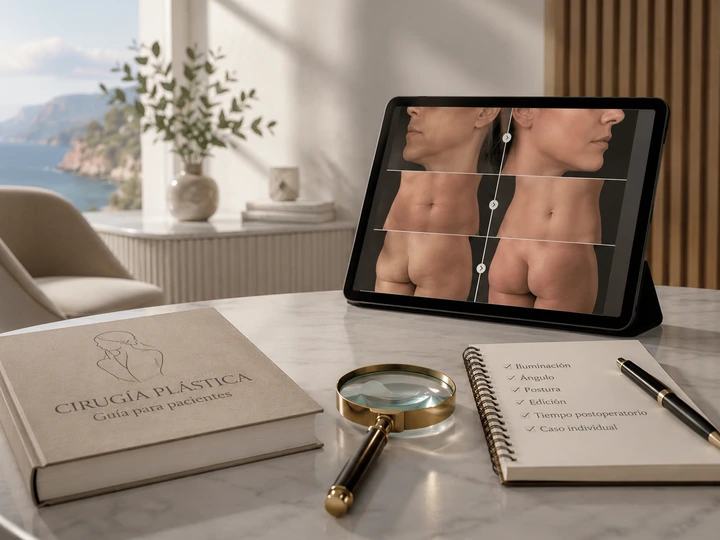
Before-and-after photos are a legitimate tool in plastic surgery consultations, but they must be evaluated carefully: same lighting conditions, identical posture, neutral clothing, and no filters or digital retouching. The best comparative photo is the patient’s own: preoperative photos of the patient are the most valuable clinical record for evaluating results after the fact. Out of respect for patient confidentiality, at Mallorca Medical Group we do not publish before-and-after photos publicly on our website; we show them during consultations with the express consent of each patient.
Why This Article Is Different
Plastic surgery websites typically publish before-and-after photo galleries as a marketing tool. At Mallorca Medical Group, we’ve decided not to do this. There are several reasons for this, and we want to explain them, because this decision is an editorial choice, not an oversight. This article also provides tools to help patients evaluate before-and-after photos when they see them—whether during a consultation with a surgeon, on social media, or on other websites.
The Confidentiality Argument
Plastic surgery is private medical information. Even if the patient signs a general consent form for publication, the actual reach of the internet—where the image will end up, for how many years, and in what contexts—is impossible to predict. A photo published today may appear on unforeseen platforms 10 years from now, when the patient may be in very different life circumstances (relationship status, job search, family situation). Out of respect for that unpredictable privacy, we have decided not to publish before-and-after images on our public website.
This does not mean that there aren’t any. During private consultations, with specific and limited consent, we show relevant cases so that the patient can see Dr. García Ceballos’s actual results in patients with similar anatomy. The difference is: a private consultation with specific consent ≠ indefinite public posting on the internet.
What to Look for in a Genuine Before-and-After Photo
1. Same technical specifications
A before-and-after photo is only comparable if the shooting conditions are identical: same body posture (front view, profile, three-quarter view), same camera distance, same framing, same lighting, same background. If the “before” photo is taken in unfavorable lighting and the “after” photo in flattering lighting, the result appears better than it actually is. In serious plastic surgery, photos are taken in the same photo studio with standardized lighting.
2. Identical or absent clothing and posture
If the patient is wearing different underwear, has a different posture, or adjusts her pose to make the “after” photo look better, the comparison is misleading. Valid clinical photos are taken without underwear (for breast, abdominal, or hip surgery) or with the same neutral undergarment in both shots. Posture: relaxed, arms at the sides, without tensing any muscles.
3. Adequate postoperative recovery time
An “after” photo taken 6 weeks after surgery is not representative of the final result. Comparative photos should be taken at least 3 months after surgery, ideally 6 months, and for some procedures (rhinoplasty, facelift) 12 months later, when the results have stabilized. A “3 weeks later” photo, with swelling still present, may show volumes that will change over time.
4. No filters or retouching
Any camera filter, lighting adjustments, or digital retouching invalidates the photo as a clinical record. Social media has trivialized the use of filters, and many “before-and-after” photos circulating online are subtly edited. In a serious medical consultation, photos are unedited and filter-free.
Warning Signs When Evaluating Photos in a Clinical Setting
- Photos without metadata or source information: if it is not clear which surgeon they are from, they may not be from the surgeon who is showing them to you
- Only perfect results: Every surgeon has both simpler and more complex cases. Showing only perfect cases can obscure the average reality.
- Cases with anatomy that is very different from yours: they are not representative of what you can expect
- Results that seem “unrealistic” given your anatomy: if your own tissue or bone structure limits the possible outcome, promising it doesn’t mean you’ll be able to deliver
- Extreme cases of aggressive advertising: Many “spectacular” cases are optimized for marketing purposes and do not necessarily represent the balance between aesthetic results and naturalness that most patients seek
The best reference photo is yours
This is what people underestimate the most: the most valuable clinical tool for evaluating your own results is your pre-operative photo. When you schedule a consultation for any cosmetic surgery:
- Make sure the surgeon (or their clinic) takes standardized preoperative photos. At MMG, we always take them as part of the medical record.
- Request a (digital) copy of those photos for yourself
- When you evaluate your results months later, compare them with your own photos: that’s the valid comparison—not against “someone who looks like you” in a commercial photo
- Please also take your own photos at 3, 6, and 12 months after surgery, under similar conditions (a bathroom mirror at home won't work; try to replicate the lighting and pose).
3D Simulation as a Complement
During consultations for rhinoplasty, breast augmentation, and other applicable procedures, we use 3D simulation to show patients the potential changes to their own face or body. Simulation is a communication tool—it helps clarify expectations and discuss goals—but it is not a guarantee: the final result depends on anatomical and biological factors that no simulation can reproduce exactly. We always make this clear during the consultation.
What to Ask During a Consultation About Previous Cases
When you're in a consultation with a surgeon to discuss your surgery, it's perfectly acceptable and helpful to ask:
- How many cases like mine have you handled in recent years?
- Do you have any cases with anatomy similar to mine that you could show me?
- Are the photos you're showing me yours, taken at this clinic?
- How long after surgery were the “after” photos taken?
- Can I see an example of a case that didn't turn out perfectly, so I can understand the range of possible results?
- If I have a complication, what is your standard fee, and how do you handle it?
A reputable surgeon answers these questions honestly. If the answer is evasive or only “perfect” cases are shown, that’s a red flag.
Bibliographic References
- International Society of Aesthetic Plastic Surgery (ISAPS). Photography Standards in Plastic Surgery. isaps.org
- American Society of Plastic Surgeons (ASPS). Guidelines for Patient Photography and Consent, 2024. plasticsurgery.org
- General Data Protection Regulation (EU) 2016/679: Application to Medical Images and the Right to Be Forgotten. eur-lex.europa.eu
FAQ — Before-and-After Cases: How to Interpret Them

Dr. José Ignacio García Ceballos
Member nº 070707779 - Official College of Doctors of the Balearic Islands
Plastic surgeon with 25 years of experience. Trained at the Royal College of Surgeons of England (MRCS I England) and in Belgium (FCCP Belgium). Member of SECPRE. Creator of two patented techniques: BAGS (mastopexy) and Duvet (rhinoplasty).
It operates at Quirónsalud Palmaplanas Hospital and Quirónsalud Son Verí Hospital in Palma de Mallorca. Multilingual care is available in Spanish, English, French, and German.
Camí de la Vileta, 46 C - 07011 Palma de Mallorca - 971 254 686
Medical Disclaimer: The content of this article is for informational purposes only and is not a substitute for an individualized medical consultation with a board-certified plastic surgeon. Any decision regarding surgery requires a personalized evaluation.