
Rhinoplasty Recovery: Day by Day and Week by Week
What to expect exactly during each phase of recovery after rhinoplasty. Day by day for the first 2 weeks, week by week for the first 3 months, and up to the final results at 12 months. Honest and detailed information.
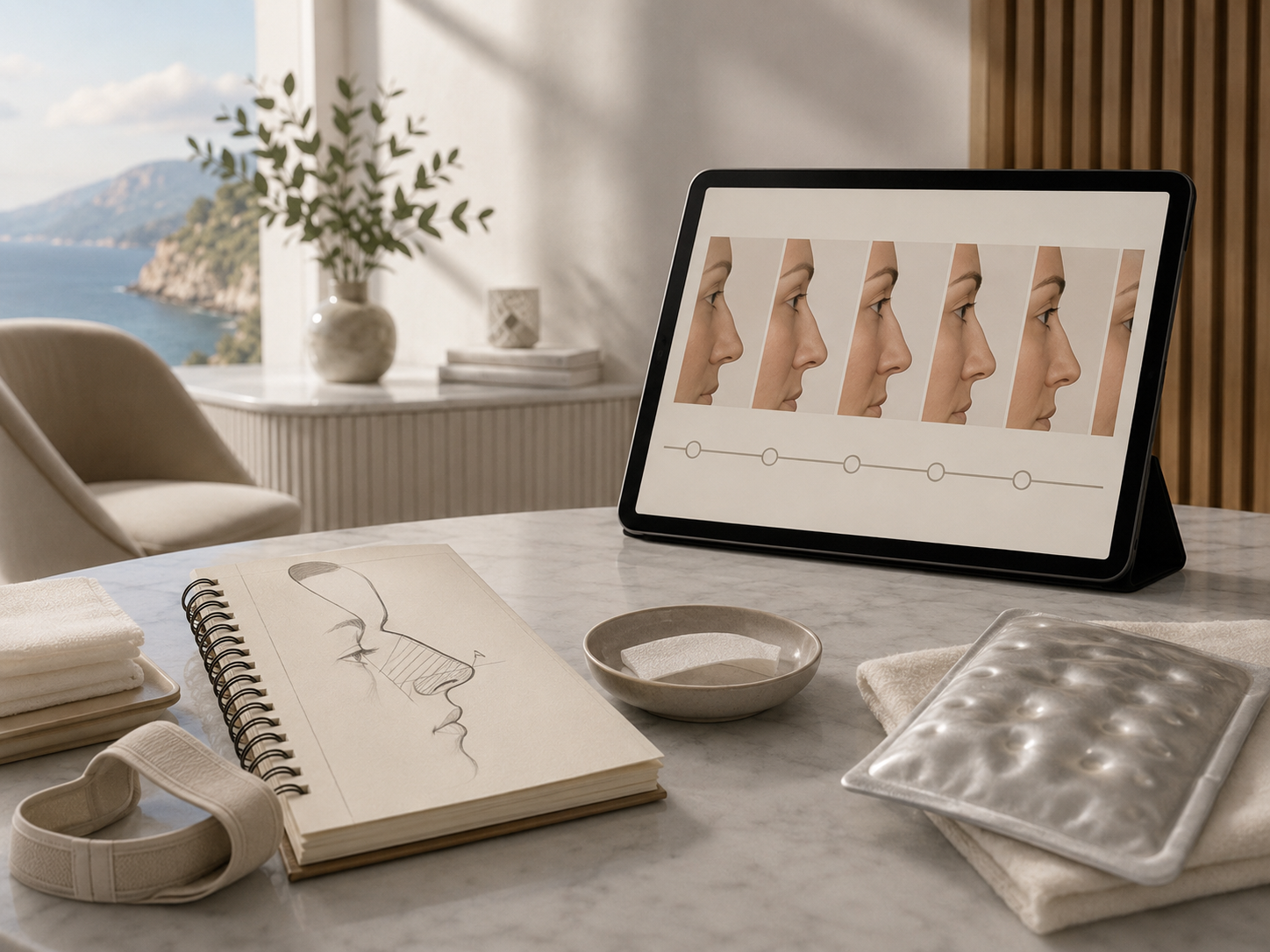
After a rhinoplasty, the first 48 hours are the most uncomfortable (not because of pain but because of nasal congestion). The splint is removed on the 7th–10th day, and from that point on, the swelling gradually subsides. Most of the results are visible after 3 months, but the final results are not fully apparent until 12 months due to the slow internal healing of the nose. The patented Duvet technique causes less swelling and allows patients to return to social activities after 10 days for remote work.
Why is recovery from rhinoplasty so different from other surgeries?
Unlike most plastic surgeries, with rhinoplasty the visible results do not stabilize within weeks, but rather over the course of months. The nose heals both internally and externally, and the internal healing process—which determines the final appearance of the nasal tip—is slow. This means that the patient will see her nose gradually change over the course of an entire year.
Understanding this timeline helps avoid unnecessary anxiety: what you see after 10 days is not the final result, nor is what you see after 2 months. Patience is part of the process. This article outlines the actual timeline of recovery for patients who have undergone surgery using the Duvet technique—the method patented by Dr. García Ceballos after performing more than 2,000 rhinoplasties.
Day 0: The day of the surgery
Rhinoplasty is performed under general anesthesia in a hospital operating room; the procedure typically lasts 2 to 3 hours for a primary rhinoplasty. Upon waking, the patient wears a rigid external nasal splint and, in some cases, internal packing (depending on whether the septum was addressed). The predominant sensation is not pain—which is mild—but severe nasal congestion: the nose is completely blocked by internal swelling and the nasal packing, if present. The patient breathes through the mouth.
In most cases, the patient is discharged on the same day. She returns home with instructions, oral pain medication, and a schedule of follow-up appointments.
Days 1–3: the most uncomfortable (but not because of pain)
The first 72 hours are the most uncomfortable, not because of the pain—which is well managed with acetaminophen or mild pain relievers—but because of a combination of minor discomforts: complete nasal congestion, dry mouth from breathing through the mouth, bruising around the eyes (the famous “panda eyes”), facial swelling, and a feeling of pressure across the bridge of the nose.
Specific recommendations:
- Sleeping with your head elevated (3–4 pillows or an adjustable bed): significantly reduces inflammation
- Apply cold to the cheeks and the area around the eyes (NEVER directly on the nose or the splint)
- Drink plenty of water: a dry mouth caused by mouth breathing leads to dehydration
- Eat soft foods at room temperature; very hot foods increase inflammation
- Avoid blowing your nose, bending down to pick things up off the floor, or any abdominal strain
If there is an internal packing, it is usually removed between the 2nd and 5th day during a follow-up visit: this provides significant relief—the patient can breathe partially through the nose again—although the congestion caused by inflammation persists.
Days 4–7: Starting to Feel Like a Person
Starting on days 4–5, the periocular bruises begin to change from dark purple to green and yellow (a sign of resorption). The general facial swelling subsides. Internal congestion persists, but is less severe. Some patients begin taking short walks and regaining their normal appetite.
With the Duvet technique, periorbital bruising is significantly less than with traditional rhinoplasty: many patients can already cover it with makeup as early as the 5th or 6th day. Residual swelling of the nasal dorsum is also less due to the preservation of structures that characterizes this technique.
Days 7–10: Removal of the splint
This is the most eagerly awaited moment of the first phase. During the follow-up visit, the surgeon removes the external nasal splint. The feeling is liberating, though it can also be surprising: the nose you see after the splint is removed is not the final result. It is still very swollen, especially the tip, which appears larger than it will eventually be. This is completely normal.
Starting now:
- Social reintegration is possible (with or without makeup, depending on residual bruising)
- Return to sedentary or remote work
- International patients can now fly back (with medical authorization)
- Apply healing ointment to the indicated areas as directed
- Nasal rinses with saline solution: 3–4 times a day for several weeks
Weeks 2–4: The Most Deceptive Period
This is the most psychologically challenging phase. The splint is no longer in place, the bruising has subsided, and the patient is returning to her normal life—but her nose is still very swollen, especially the tip. Many patients during this period doubt the outcome; they find themselves constantly looking in the mirror, comparing both sides (which may not be symmetrical due to the swelling), and become anxious.
This is completely normal. What you see during these first few weeks is not the final result. The internal swelling in the nose takes months to subside; the external swelling, weeks. Trust the surgeon who performed your surgery and give the healing process time. It’s common for the bridge of the nose to look narrower and the tip to look fuller than they will in the end.
Months 1–3: The Gradual Transition
Starting in the first month, the nose begins to take on its recognizable shape. The swelling gradually subsides, especially on the bridge. The tip remains the area that heals most slowly. By about 3 months, approximately 70–80% of the final result is already visible: the nasal profile, projection, and rotation of the tip are largely defined, although the finer details continue to improve.
During this period:
- Resume low-impact exercise after 4–6 weeks (walking, stationary bike)
- High-impact exercise starting at 6–8 weeks (light running, gym)
- Contact sports and swimming that carry a risk of head injury: at least 3 months
- Strict sun protection on the nose for 6–12 months (sensitized skin may become pigmented)
- Do not wear glasses that rest on the bridge of the nose until the 2nd–3rd month (sunglasses or prescription glasses may require a nose pad).
Months 6–12: Toward the Final Result
Between 6 and 12 months, the residual internal swelling in the nose gradually subsides, especially at the tip. It is common for the patient to notice subtle changes each month: the tip becomes more defined, the contours become more refined, and symmetry is achieved. By about 12 months, the result is final: what you see at that point is what will remain.
In some cases, especially with thick skin or in secondary rhinoplasties, internal swelling can last up to 18 months. Every patient heals at their own pace.
When to Be Concerned: Signs That Aren't Normal
Although most of the recovery process is predictable, there are signs that require immediate contact with the clinic:
- Severe pain that does not subside with prescribed analgesia
- A fever higher than 38 °C at any time during the postoperative period
- Heavy, continuous nosebleeds (some light bleeding during the first few days is normal)
- Sudden asymmetric swelling or increased pain after several days of stability
- Purulent discharge from visible scars or through the nostrils
- Sudden loss of facial sensation that does not return
Bibliographic References
- Royal College of Surgeons of England. Rhinoplasty Recovery Guidelines for Patients. rcseng.ac.uk
- Spanish Society of Plastic, Reconstructive, and Aesthetic Surgery (SECPRE). Patient Information on Rhinoplasty. secpre.org
- García Ceballos, J.I. The Duvet Technique in Primary Rhinoplasty: Postoperative Benefits and Recovery Timeline. Internal presentation, Mallorca Medical Group, 2026.
FAQ — Day-by-Day Rhinoplasty Recovery
Dr. José Ignacio García Ceballos
Member nº 070707779 - Official College of Doctors of the Balearic Islands
Plastic surgeon with 25 years of experience. Trained at the Royal College of Surgeons of England (MRCS I England) and in Belgium (FCCP Belgium). Member of SECPRE. Creator of two patented techniques: BAGS (mastopexy) and Duvet (rhinoplasty).
It operates at Quirónsalud Palmaplanas Hospital and Quirónsalud Son Verí Hospital in Palma de Mallorca. Multilingual care is available in Spanish, English, French, and German.
Camí de la Vileta, 46 C - 07011 Palma de Mallorca - 971 254 686
Medical Disclaimer: The content of this article is for informational purposes only and is not a substitute for an individualized medical consultation with a board-certified plastic surgeon. Any decision regarding surgery requires a personalized evaluation.